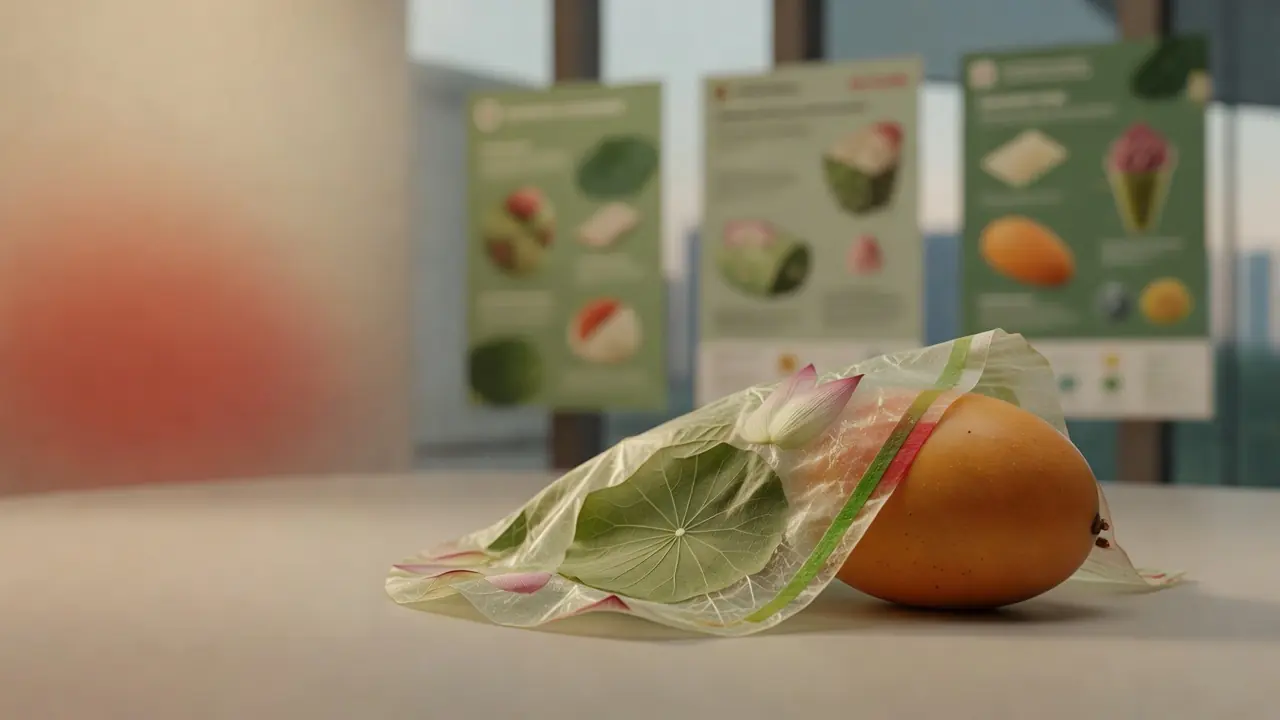
A student team from the Ho Chi Minh City branch of the Foreign Trade University took first place at the Student Innovation Showcase 2026 with SENBAO, a food wrap made from lotus by-products that can signal when food is starting to spoil. The award was presented during the 5th Trans-Pacific Sustainable Development Dialogue in Singapore on October 25 and 26, beating a field of nearly 300 projects submitted by universities worldwide.
How the Wrap Is Meant to Work
SENBAO starts from a practical problem: much everyday food packaging is made from materials that do not break down easily, and food often goes to waste before it is eaten. The team's approach is to use agricultural by-products, in this case parts of the lotus plant that are usually discarded, as the base material for a wrap that helps preserve food. The design also includes the ability to identify signs of food spoilage, which is the feature that gives the product its "smart" label.
According to team leader Tran Tin Dung, the wrap could replace non-biodegradable packaging, support food preservation, and help improve food safety by reducing the chance that spoiled food is eaten or thrown away late. The public description of the project does not detail the chemistry of the spoilage indicator, the preservation performance under different conditions, or how long the material lasts, so those points remain open questions.
Why the Competition Matters
The showcase is organized around the United Nations Sustainable Development Goal 12, which covers responsible consumption and production. The program seeks student solutions to global environmental problems and encourages young people to take part in building a sustainable future. The event was organized by the Center for Asia-Pacific Studies at Stanford University and the Ban Ki-moon Foundation "For a Better Future," in collaboration with Singapore Management University. Organizers narrowed the nearly 300 submissions to 15 finalists for the presentation round in Singapore. The SENBAO team defended its idea before judges from institutions including the National University of Singapore, Stanford University, and Yonsei University, and former UN Secretary-General Ban Ki-moon presented the award.
What This Could Mean for Households
For American readers, the project is a signal of where food packaging research is heading rather than a product that can be bought now. Plant-based and waste-reducing wraps already appear in some markets, and spoilage indicators are an area of active development in food packaging generally. A wrap that both reduces single-use plastic and flags spoiling food would address two household frustrations at once, but any consumer use would depend on testing, regulatory approval, and commercial production that the public material does not describe.
Until such products are available, the most reliable steps for home food safety are the familiar ones: check use-by and best-by dates, keep perishable foods refrigerated, and discard food that smells, looks, or tastes off. A clever wrap can support those habits, but it does not replace them.